electronicsleader

  • Subscribe to our RSS feed.
  • Twitter
  • StumbleUpon
  • Reddit
  • Facebook
  • Digg
Showing posts with label Union Square July 20 2013. Show all posts

Tuesday, 20 August 2013

Echoes of the Past in Union Square August 20, 2013...

Posted on 18:11 by Unknown


Sort of a hot day in Union Square Park, but this is August yet...
There are so many echoes of the past lingering here, even though the bulldozed Union Square at one time and started all over..

The great statue of one of my favorite people, Mahatma Gandhi, is still in the Southwest corner of the Park..

And it sure looked to me like some of the people around me had been smoking stuff if you know what I mean..

Finally, I heard the chanting of " Hare, hare" and music to go with it and I was reminded when people like this were all over the Village from time to time...no one paying attention to these people, but in the past nobody paid that much attention to them either..

I want to find something special about Union Square's past to run here...I wonder what I can find 

The site Forgotten New York often comes to the rescue, and I feel it does again

Share on Twitter
Union Square was named (actually as Union Place) in 1815 at the near-junction of the Bloomingdale Road, or Post Road to Albany, and the northern part of the Bowery Road, the Post Road to Boston. In the original Commissioners’ Plan drawn up 1807-1811 by surveyor John Randel, Broadway was originally going to run “north” above Tenth Street and end at a 239-acre military training ground called The Parade spanning between 3rd to 7th Avenues and from 23rd to 34th Streets. By 1814, however, the idea for The Parade had been scrapped as the new Third Avenue diminished the Post Road’s importance, and emphasis was then placed on Broadway as a main north-south route up Manhattan Island. To do that, it took a northwest angle.
bway-bowery
parade
Left: map showing Broadway, Bloomingdale Road and Bowery Road in the early 1800s, before the street grid was laid out. All the main roads shown on this map are still in existence: Bloomingdale Road is now Broadway, Bowery Road is 4th Avenue, and Astor Place and Stuyvesant Street are still there. The V formed by the convergence of Bowery Road and Bloomingdale Rd. is now overlaid by Union Square. Above: Randell Plan of 1807, showing The Parade. map: The Greatest Street in the World: Broadway, Stephen Jenkins, J.P. Putnam’s Sons 1911
By 1839 Bloomingdale Road was renamed Broadway all the way to what became Columbus Circle, and then Broadway a few decades later all the way to the Harlem River and beyond. And, by the late 1850s, The Parade was finally replaced by Central Park, and the Post Road was gradually closed in sections north of 14th Street beginning in the 1830s, to resume in the Bronx.
Union Place, the meeting of the Bloomingdale and Bowery Roads, was so named by 1815, but served time as a potter’s field and a place for squatters until the park’s present configuration west of 4th Avenue (Union Square East), Union Square West (Broadway) East 14th Street and East 17th was finally laid out and landscaped as the modern street grid had reached that far uptown by then. After a short stint as Union Park, the name Union Square was settled on by the 1870s. The square is named for the junction of roads, not the Union (USA, vs the Confederacy) or later gatherings by trade unions that took place there.
In the mid-1800s, Union Square was actually the home of NYC’s entertainment district, that had crept north along the Bowery since the post-colonial era. The story of Union Square’s nightlife era is best told in Luc Sante’s excellent book Low-Life. In 1856, the first of Union Square’s well-known landmarks first appeared.


08-washington
09-washington
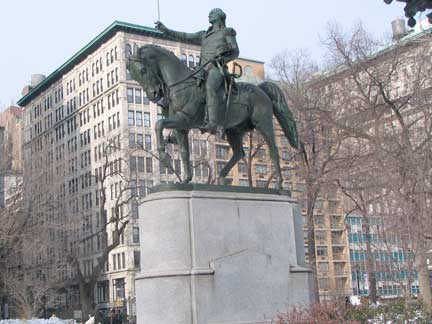
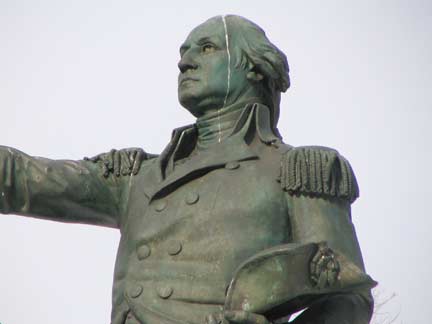
Henry Kirke Brown’s bronze mounted statue of George Washington was NYC’s first major outdoor portrait statue. It was just the second mounted statue produced in the USA, following Clark Mills’ Andrew Jackson in Washington, DC. This Washington portrays his reclamation of NYC from the British after their surrender in 1783, which was supposed to have taken place in the vicinity of where University Place meets 14th Street today. It was first set up in the middle of the intersection, protected from what was then mounted and wagon traffic by a fence, but it was moved soon enough to its current location facing East 14th. The statue does go against mounted statuary tradition in that one horse’s leg raised usually indicates the rider died from wounds suffered on the battlefield; Washington died at Mount Vernon on 12/14/1799.
01-brighter
02-brighter
03
04-brighter
05-brighter
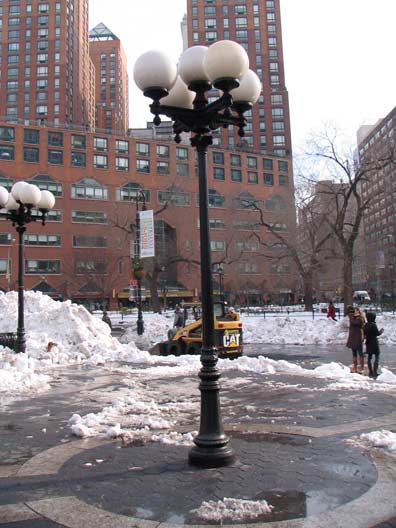
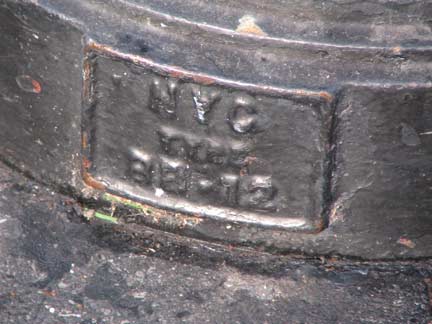
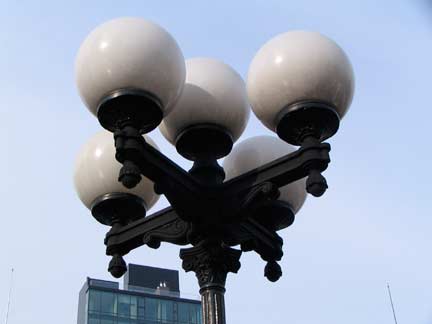
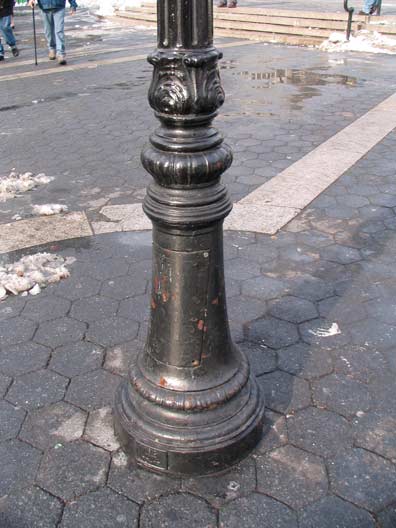
At the southern edge of Union Square stands a flock of castiron lamps that had drifted under my radar for several years. Their pedigree is the “Brighter Brooklyn” postsinstalled in that borough in the early 1900s. Gradually they had disappeared over the decades until only three were left. The city shipped one of them to the Spring City lighting company, which produced several reproductions that were installed in Union Square during the latest of several renovations in the late 1990s.

Union Square accumulated some of the city’s most distinctive architecture beginning in the post-Civil War period. The building shown here on the right is actually the oldest of the three in the picture!
On the left is the Romanesque Lincoln Building, on the corner of Union Square West and East 14th (that sounds impossible, but that’s how they name streets here…) It was designated a NYC Landmark in 1988, and was designed by architect R. H. Robertson 99 years before that. The buildings surrounding Union Square were designed at the dawn of the skyscraper era.
In the center is the Spingler Building, architects William H. Hume and Son, 1897. It originally contained stores, showrooms, manufacturers and industrial lofts. Note the tripartite style, an architectural sandwich: two floors with wide windows at the bottom, yellow-bricked center, and attic floor and cornice. The name harkens back to the Spingler House, a hotel formerly in the locale — a Henry Spingler owned much of the land here in the colonial era.
“Henry Spingler was a market gardner. He lived at the end of the eighteenth century on the Bowery, at the corner of that thoroughfare and Broadway, now Fifteenth Street and Union Square, and owned a vast tract of land that now is covered with splendid business buildings. The house was a quaintly built Dutch structure. It was said that he had inherited the house and lands, or, rather, acquired them, from being the steward of another man, who had given them into his keeping and who had gone to Europe and never returned. He was, however, shrewd and industrious, and improved and increased the estate. He died in 1814 and left two children, one of whom married Lieut. James Fonerden, son of the famous Baltimore Abolitionist. The daughter of this union was Mary Spingler Fonerden. She married Michael Murray Van Buren. It was a love match. The young man had been a mechanic. They removed in 1833 to a house built on the site of the present one [21 W. 14th St.] which stands in the centre of the Spingler estate, the boundaries extending to Seventh Avenue on one side, and to Union Square on the other.”  from Walter Grutchfield, 14 to 42
tiffany-union2_
tiffany-union_-sq_
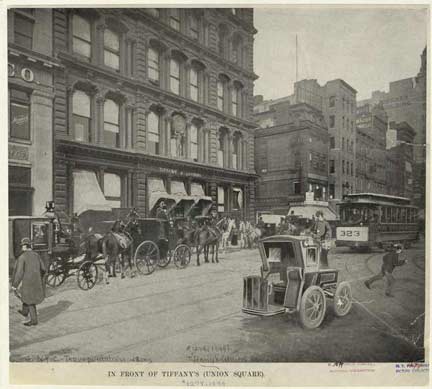
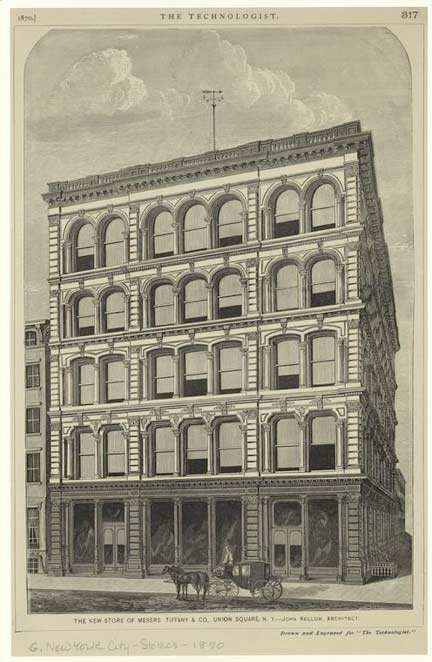
The building on the right - the one that looks like metal and glass boxes stacked together — is the oldest of the group and was originally built in 1870 as the first Tiffany jewelry store in NYC. John Kellum designed what was at first an elaborate cast-iron fronted building. The Times called the new building a “palace of jewels,” with black-walnut counters and ebony cases holding watches, fans, opera glasses and other articles in wood, leather, silver, cloisonné, enamel, bronze and rosewood. NY Times, July 2, 2006
Tiffany moved uptown in 1906. NYPL archives

06-subwaykiosk
28-kiosk_
29-subwaylight
31-newsstand
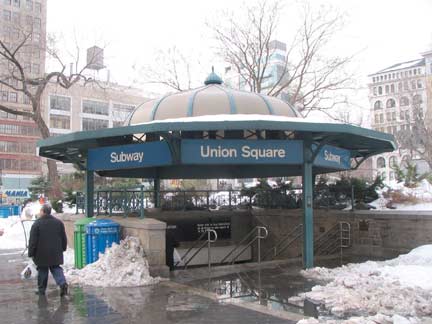
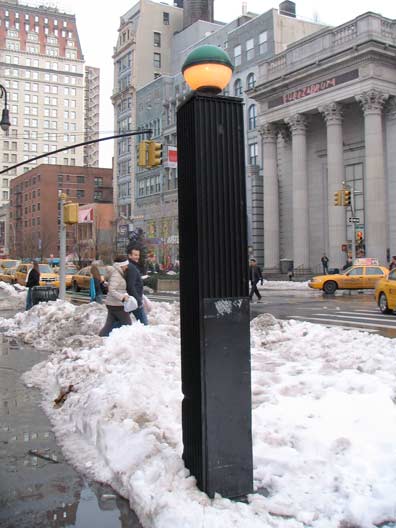
By coincidence, Union Square’s “union“ can also apply to the junction of three separate major subway trunk lines, the IRT Lexington (4, 5, 6), the BMT Broadway (R, Q, N) and the BMT Canarsie (L). In one of Union Square’s waves of renovation, unique station entrance canopies that are found nowhere else in the system were installed, in addition to decorative newsstand kiosks (though this one may be threatened by the new CEMUSA newsstands being installed all over town. There is also a boxy subway entrance indicator lamp stanchion.
13-fountain
charity
firgure
union-1897
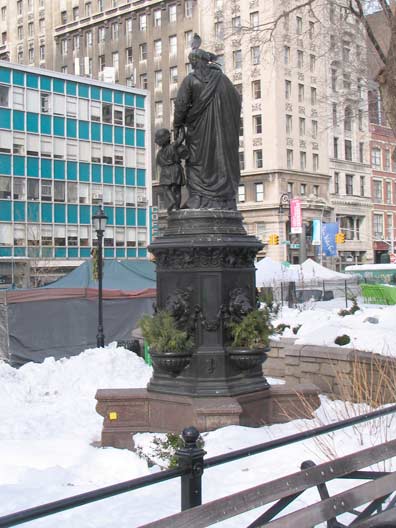
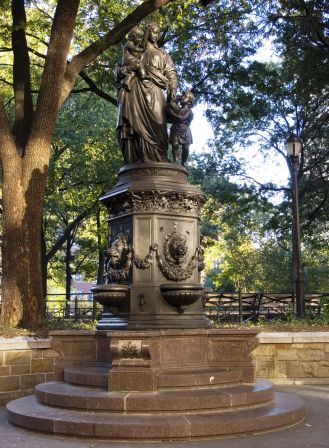
The Daniel Willis James Temperance Fountain facing West 15th and Union Sq West was cast in 1881 by sculptor Karl Adolph Donndorf and depicts a female figure representing Charity holding a baby and offering a drink to her young son. The figures were modeled after the sculptor’s wife and children.
“Temperance fountains” offering free drinks of water were in vogue in the late 19th Century to promote health, cleanliness and of course, abstinence from alcohol. They were the brainchild of James, who headed the Phelps, Dodge mining company, and Theodore Roosevelt, then a NY State Assemblyman. James funded the fountain.
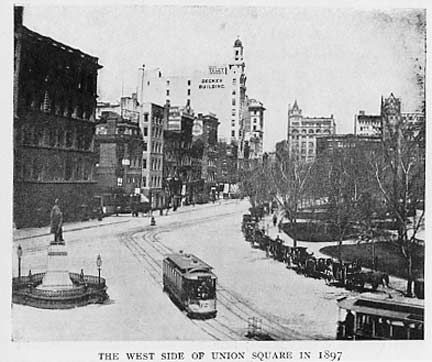
Originally water issued from the 4 lions’ heads and tin drinking cups hung from chains alongside. In photo left taken from the Stephen Jenkins book refered to above, the fountain was in the triangle at Union Square West and East 14th in 1897.

I wasn’t able to get close
 to the Charles F. Murphy Memorial Flagpole because of snow accumulation and the closure of the lawn for seeding. A better closeup photo can be found on this flickr page. The bronze bas-reliefs by sculptor Anthony De Francisci (sculptor of thePeace Silver Dollar in use from 1921-1935) depict the Declaration of Independence and its signatures; the effects of tyranny; the effects of liberty; and emblems of the USA’s first thirteen colonies.
The flagpole and its base were the gifts of the Tammany Society and at first honored Murphy, a former Tammany boss. It was also nicknamed the Independence Flagstaff as some public sentiment was against honoring a Tammany chieftain.
I don’t know much about the 1950s or 1960s office building it’s in, but The Coffee Shop has been a mainstay at Union Square and East 16th for over 20 years, even before it was cleaned up and was a main headquarters for drug dealers.


22-decker
15-unionsq-west_-16
21-bank_-of_-metropolis
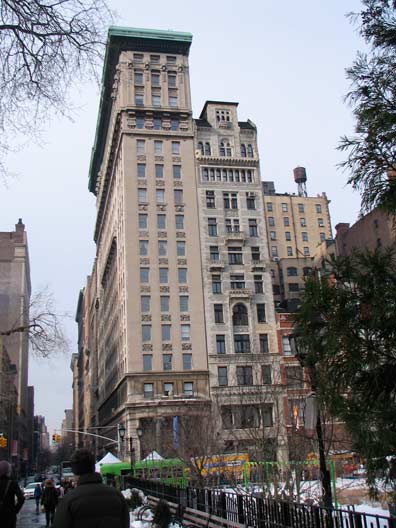
The buildings on the NW corner of Union Square West and East 16th Street also date from the dawn of the skyscraper era. At left is the slivery 1903 Bank of the Metropolis Building (Bruce Price, architect) that is actually wider on the 16th Street side. The bank was founded in 1871 and was absorbed by the Bank of Manhattan in 1908, just 5 years after the building opened.
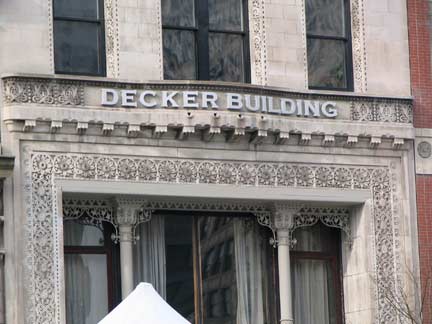
The Decker Building was completed in 1893 by architect John Edelmann, an associate of Louis Sullivan. The Moorish-style building was the home of the Decker Piano Company when it opened, replacing an earlier Decker Piano building. This was home to the second location of Andy Warhol‘s Factory between 1968-1974; it was here that a disturbed Valerie Solanas shot and wounded Warhol June 3, 1968 — she thought he had stolen a screenplay of hers.
14-unionsq-north_
23-bn_
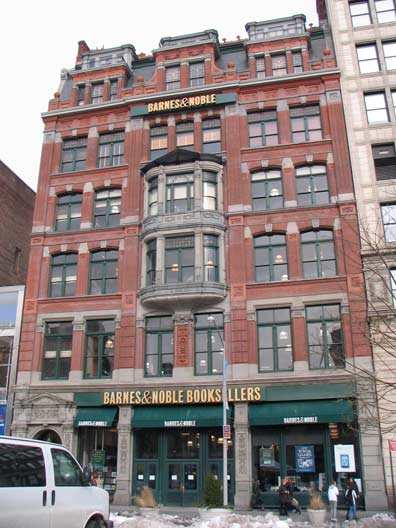
Moving to East 17th on the north side of Union Square, the building on the left, corner Broadway, was home to Warhol’s last Factory from 1974-1987. Two doors down is the red brick Queen Anne-style Century Building (1881, architect William Schickel) originally home to The Century Magazine and St. Nicholas Magazine for children (which, oddly enough, I remember from seeing reprints of it in the library as a kid). For almost 20 years it has been home to a branch of Barnes and Noble booksellers, and continues in that role as of January 2011; other B&Ns around town have fallen victim to rising rents and new electronic transfer of books.
16-arch1_
17-arch2_
Union Square’s north end limestone arch, flanked by two Ionic-columned pavilions, was built in 1929. Though the south end of the park is now where most demonstrations take place these days, the pavilion has historically been the site for marches, sit-ins and protests through the years. Plans are afoot to make the pavilion the centerpiece for an upscale restaurant. A new playground opened adjacent to it in 2009.
18-lincoln
19-lincoln
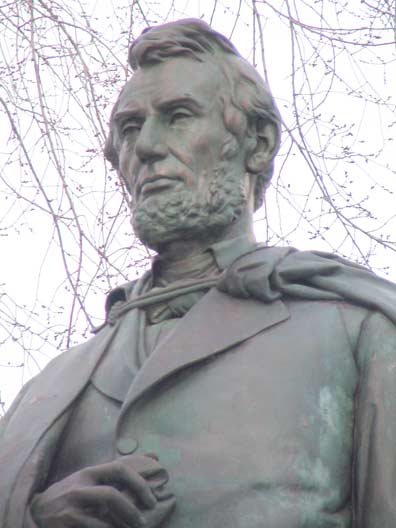
Just as a Henry Kirke Brown bronze of George Washington dominates the south end of the park does a Brown Lincoln bestride the north end. This was the first statue of Lincoln to appear in NYC after his assassination in Washington in 1865, as it was installed in Union Square three years later. A similar Lincoln statue also sculpted by Brown is in the Picnic Grove in Prospect Park in Brooklyn.
24-ny_-film_-academy
25-crown_-coat_-front_
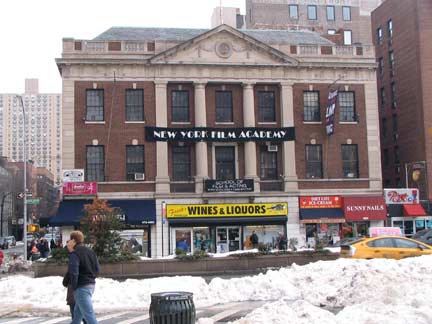
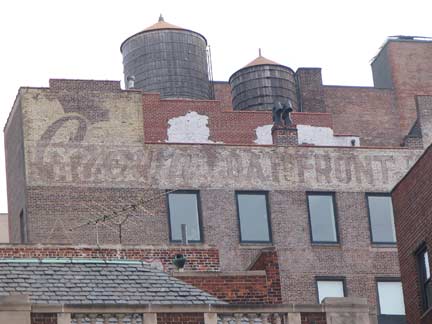
At Union Square’s northeast end, East 17th and Union Square East, is the last version of Tammany Hall, constructed in 1928. Tammany Hall was an organization associated with the Democratic Party that dominated NYC politics for about a century, from the 1830s through the 1930s. The name was a bowdlerization of the name of a (likely fictional) Indian chief. A film school, New York Film Academy, now occupies much of the building. On East 16th, a wide painted ad advertises Crown Coat Fronts (out of the picture to the right, a smaller sign says ” Mftr’s of Civilian and Military Coat Fronts.” According to Walter Grutchfield, the company was here between 1947 and 1958. “Coat fronts” were a ”trade term for a built-up stiffening or shape-retaining interlining for the fronts of coats, made of stitched layers of haircloth, felt and canvas.”
Look closely at the left side of the Crown ad, and you can see that the paint has worn off sufficiently to allow a glimpse of the painted ad that preceded it, for Hyman and Oppenheim Human Hair Goods.
26-lafayette
27-lafayatte
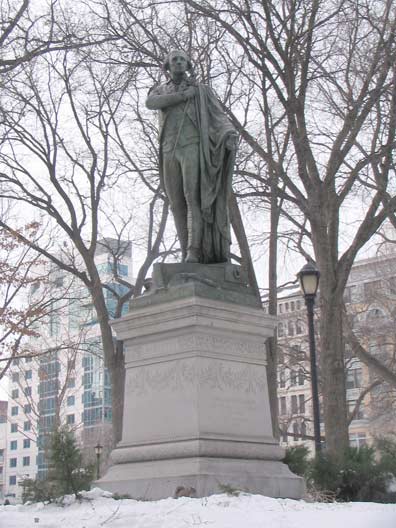
Frédéric-Auguste Bartholdi’s Marquis de Lafayette faces Union Square East and East 15th was dedicated in 1876, the USA Centennial. He was a staunch ally of the USA and became a close friend of George Washington, and his aid enabled the USA to win several crucial battles, most notably the Battle of Yorktown. France wavered in its support of the USA after the Revolution, but Lafayette continued on as a legendary and revered figure in the USA. He returned for a triumphal visit in 1824. If you are familiar with the name Bartholdi, you know that Liberty Enlightening The World, the Statue of Liberty, was also a Bartholdi work ten years later, in 1886.


Corinthian-columned, monumental Union Square Savings Bank, Union Square East and East 15th, was built in 1905 as a mini-Greek temple worshiping thrift. Its architect was Henry Bacon of the Lincoln Memorial and thousands of NYC park lampposts.
1/4/11
Read More
Posted in Union Square July 20 2013 | No comments
Older Posts Home
Subscribe to: Posts (Atom)

Popular Posts

  • The History of Dunkin Donuts
    Dunkin Donuts has outlets all over Manhattan, and some are much better than others ( one not that far from me was terrible and has just clos...
  • Subway Sandwiches-- History
    OK, I would never go to a Subway sandwich store because I have hated the ads they have on TV. They have done very well pleasing their target...
  • Whatever happened to Cabrini? Another ill fated Manhattan hospital
    The Cabrini Medical Center was once a pretty well respected place in Lower East Midtown and I noticed in recent years that it looks abandone...
  • Baruch School of Business...wow, has this place grown over the years!
    Years and years ago I knew a whole bunch of people on the Psychology faculty of Baruch..my, how the place has grown since then...even expand...
  • Architectural investigator-- 328 East 62nd Street...the typical Manhattan utilitarian building
    I could not resist wanting to do a building like this near an off ramp of the 59th Street Bridge because it is SO much an old warehouse-type...
  • Trader Joe's Wine Store
    Of course, I know nothing of this place for one reason because I don't drink any more... Yelper's..tons of reviews, not everyone...
  • Five Napkin Burger
    I must have burgers on my mind lately because I just realized I am showing a lot of places that serve them ( I have not had a burger in ages...
  • SUNY Eye Care Center on West 42nd Street
    Now, this is a place that I have personal experience with--for years--and a good place to end for tonight. While I found Lenscrafters to be ...
  • Amish Market
    Amish Market in Midtown Manhattan? I mentioned this to someone and they asked if all the goods were delivered by horse and wagon (No.). Let ...
  • Hilton Hotel East 42nd Street near Tudor City
    Tucked away on East 42nd Street is a Hilton Hotel which I have often noticed but never heard or read anything about. I have no idea what Yel...

Categories

  • Union Square July 20 2013

Blog Archive

  • ▼  2013 (500)
    • ▼  September (123)
      • Lhosa wants more debates with DeBlasio- NY Times
      • Third Avenue Ale House
      • NYC Sports Clubs Midtown East
      • Brother Jimmy's Upper East Side
      • Google Revamps Itself- from the BBC
      • Hiroshi Yamauchi, electronics leader, dies
      • Pope Announces Shift in Church Focus- Barrie Examiner
      • New Genetics Center: NYC Institutions Say They Wil...
      • Has the U.S. Gone Wrong in Egypt, or is this whole...
      • Barneys 660 Madison Avenue
      • Yelp Pick: Maison du Croque Monsieur in Greenwich ...
      • Dr. Who?
      • From WNYC-- a problem not just in NY area
      • "Revolution in Bike Safety" from 360 Celsius--via...
      • Chinatown Restaurant Yorkville
      • 2nd Avenue Deli, Upper East Side
      • Effy's Cafe Bistro Yorkville
      • bonobos- mens' store in Flatiron district
      • Effects of Hurricane Sandy still being felt in NYC...
      • Income Inequality Increases
      • The Uneven Economic Recovery- from the New Yorker
      • Latest Note on computer repairs
      • No Blogger Until I Get My Computer Back
      • Per Lei
      • Who goes to the Banshee Pub?
      • Hurricane Season Finally Begins--from Accuweather
      • No Cute Kittens Tonight-- Instead we present the B...
      • Did being a woman (much less a lesbian) help defea...
      • WNYC seems to focus on gender factors today--
      • Deterioration of the Apple Store and "Apple Care"-...
      • May Soon Be Having Another Break, Time for Compute...
      • Who the hell is Joe Lhota?
      • Yes, Fashion Week is Here
      • Th DeBlasio Family as a Political Factor- from New...
      • Bottega del Vino Midtown East
      • Rainbow Store--"The Best General Store in Town"-It...
      • The Carriage House
      • As We Remember September 11th....a fasciating, swe...
      • If DeBlasio becomes Mayor, what about the Business...
      • New Apple iPhones and the Black Market
      • Sikh Men and the Meaning of Turbans
      • Jean Claude II Bistro
      • Pottery Barn Kids
      • La Mediterranee
      • Lasagna Ristorante
      • Finngeans Wake Pub
      • Income Inequality Increases in the United States
      • Not a Trendy Hotel This Time: The Value of Sufferi...
      • Crunch Fitness
      • Energy Kitchen
      • Ali Baba Terrace
      • Helmut Lang
      • Pio Pio
      • Primary Eve and Unwanted Phone Calls
      • The Gansevoort- Does Not Seem Ready for Five Stars
      • JJ Hat Borsalino Hat Center
      • Vanderbilt Y
      • Amish Market
      • Stanford Hotel
      • Mayhem and Stout
      • New York Manhattan Hotel
      • Millessime
      • Latest on Brain Science from NY Times
      • Obama Calls Putin "Jackass" at G20:Story of the Da...
      • resto
      • La Quinta Inn- Landmark Building
      • Tavern 29
      • Meli Greek Restaurant
      • Radisson Martinique
      • Linda's
      • The Royal Sports Bar
      • Five Napkin Burger
      • Also from WNYC= Use and Abuse of "Molly"
      • from WNYC-- Syria situation stumps American media ...
      • Cosi- Broadway, Village
      • Ironside TV series (new)
      • Jeffrey J (Indyke) Salon
      • Wall Inset Pix, Broadway IRT subway downtown side ...
      • OMG in the Village ,-- "The Jeans Store" (looks to...
      • Best Buy Union Square
      • Pescatore
      • MUMBLES
      • JAM Paper and Envelope
      • Joshua Tree in Murray Hill
      • The Smart Watch is Here-- Memories of Dick Tracy
      • More Progress Made In Developing Self Driving Cars...
      • Ephemeral NY Site- The Hendrik Hudson Apartments
      • Pampering or Punishing Employees? Very Funny Blog ...
      • The Bean
      • Jackson Hole on Third Avenue Murray Hill
      • Raymour and Flanigan
      • P.C. Richard East 14th Street
      • Trader Joe's Wine Store
      • Trader Joe's 14th Street East
      • Hilton Hotel East 42nd Street near Tudor City
      • Fashion Week in NYC and the rest of America
      • Jewish High Holy Days and Rosh Hashanah
      • Tech problems right now, hope to continue tomorrow
      • Labor Unions in the United States
      • How We Came to Celebrate Labor Day in America
      • Labor Day in NYC
      • Architectural Investigator-- 212 East 39th Street ...
      • Subway Sandwiches-- History
      • Bar 515 Third Avenue
      • Architectural Investigator-- 444 East 57th Street
      • Health Smart Murray Hill
      • The History of Dunkin Donuts
      • The New York Daily News
      • Tudor Farms store
      • Tudor City History
      • Tudor City--Labor Day 2013
      • Jacqueline Kennedy Onassis interviews; John. F. Ke...
      • New York Mayoral Elections-- Latest Articles--DeBl...
      • Mystery Building--supposed to be 180 East 72nd Str...
      • Architectural Investigator- 318 East 62nd Street
      • Website with News and Merchandise for Local Kips B...
      • Architectural Investigator: 232 East 30th Street
      • Bergino Baseball Clubhouse-- Raves from Fans
      • Ornate Upper West Side Houses of Worship
      • Delightful Art Installation at Times Square Subway...
      • Like the Apthorp, the Belnord is another huge Uppe...
      • NY Daily News reports on Why City has Canceled Fes...
      • New Google Car
    • ►  August (322)
    • ►  July (55)
Powered by Blogger.

About Me

Unknown
View my complete profile